



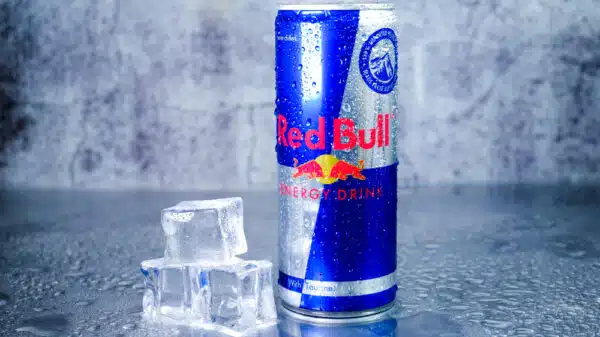


Ask a dozen people to describe the taste of an original Red Bull, and you will likely receive a dozen different answers. Some might point to the tartness of a Granny Smith apple, while others compare it to liquid Sweet Tarts, medicinal syrup, or even a citrusy bubblegum. This ambiguity isn’t an accident; unlike a soda that markets itself as “cola” or “root beer,” Red Bull occupies a unique flavor space that is defined more by its chemical composition than by any fruit found in nature.
The mystery is fueled by the brand’s own discretion. On the back of the iconic blue-and-silver can, the ingredients list simply mentions “natural and artificial flavors.” Even on major retail platforms, the flavor is often listed tautologically as “Red Bull.” To understand why it tastes the way it does, one has to look back to its heritage. The beverage is a carbonated evolution of Krating Daeng, a non-carbonated Thai energy drink originally marketed to truckers and laborers in the 1970s. When it was adapted for Western palates by Dietrich Mateschitz, the focus remained on function over culinary familiarity. The result was a profile that prioritizes a “bite”—a sharp, invigorating sensation that tells the brain something powerful is being consumed.
How Red Bull’s ingredients influence its flavor
The reason Red Bull tastes “industrial” or “medicinal” to some is because its flavor profile is intrinsically tied to its active components. It is a functional beverage first and a refreshment second. One of the most prominent notes is a sharp, clean sourness. This isn’t the complex zest of a lemon, but rather the pure acidity of citric acid. Citric acid acts as a preservative while providing that immediate “zing” that cuts through the heavy sweetness of the added sugars.
Speaking of sweetness, the combination of sucrose and glucose is used to mask the naturally bitter profile of its functional ingredients. The most notable of these is taurine, an amino acid that plays a role in various metabolic processes. In its pure form, amino acids often carry a bittersweet, slightly metallic tang. When combined with the carbonation and high sugar content, this creates the “chemical” sweetness that many consumers have grown to crave. It is a flavor profile that echoes the drink’s origins in Thai pharmacies; it tastes like it’s doing something because it carries the DNA of a tonic rather than a fruit juice.
Flavored Red Bull does exist
While the original remains the gold standard for many, Red Bull has spent the last decade expanding its “Editions” line to cater to those who prefer a more recognizable fruit profile. These varieties use the same base of caffeine, taurine, and B-vitamins but layer on specific flavorings that are much easier to identify.
The brand has turned its seasonal releases into a cult phenomenon, often experimenting with sophisticated pairings. Recent and upcoming rotations include the likes of Cherry Sakura and the tart, citrus-heavy Sudachi Lime—a fruit native to Japan. Other permanent fixtures like the Peach Edition and Iced Vanilla Berry show the brand’s pivot toward more “lifestyle” flavors that mimic the experience of a premium soda or a cocktail mixer. These editions essentially “tame” the wild, medicinal edge of the original formula, trading the mysterious “Red Bull flavor” for the approachable sweetness of summer fruits and berries.
Ultimately, the original Red Bull remains a fascinating anomaly in the beverage world. It is one of the few products globally that has achieved massive success without its primary flavor being anchored to a specific food or plant. It doesn’t taste like a strawberry or a grape; it tastes like energy. This distinctiveness is exactly what has allowed it to remain the benchmark of the category, proving that sometimes, a flavor doesn’t need a name—it just needs an effect.